



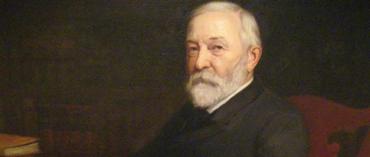
With Mike Pence becoming the latest vice presidential hopeful from Indiana and that state hosting an important Senate contest, it’s as good a time as any to ponder the only president the Hoosier State ever produced.
Saturday marks the 183rd anniversary of Benjamin Harrison’s birthday. Sandwiched between Grover Cleveland’s two non-consecutive terms, our 23rd president simply doesn’t rank as one of the giants of American history. The great writer Thomas Wolfe’s assessment in his “The Four Lost Men” story is rarely challenged as he lumped Harrison alongside other Civil War generals who served as president with no distinction during the Gilded Age.
“Garfield, Arthur, Harrison and Hayes were the lost Americans: their gravely vacant and bewhiskered faces mixed, melted, swam together in the sea-depths of a past intangible, immeasurable and unknowable,” Wolfe wrote.
Despite Wolfe’s memorable lines, Harrison might be worth another look. Granted, Harrison made more than his share of mistakes, especially when it came to economic policy. He backed the highest tariff in American history which was masterminded by a rising Ohio congressman by the name of William McKinley. Using that additional revenue, Harrison oversaw unprecedented growth of federal expenditures as the budget topped $1 billion for the first time in American history. Harrison also tried to walk a tightrope on the currency question, angering supporters of both gold and silver.
But Harrison also served as an important transitional figure in the presidency. Despite an often contentious relationship with Secretary of State James G. Blaine, who always had his eyes on the presidency for the better part of five election cycles, Harrison was far more active in foreign policy than other Gilded Age presidents. Harrison hosted the inaugural International Conference of American States and focused more on the Pacific and Latin American than his predecessors. Taking a page from Chester A. Arthur, Harrison pushed for an expanded and modernized Navy. By the time Harrison left office, America was quickly headed towards the global stage.
On the domestic side, Harrison backed more civil rights for African Americans, going far behind the other three presidents who made up Wolfe’s “Four Lost Men.” Harrison also pushed for government reform, bringing in an up-and-coming New Yorker by the name of Theodore Roosevelt to Washington as they looked to improve the civil service. While generally favoring pro-business policies, Harrison also signed the Sherman Antitrust Act into law.
In short, Harrison was something of a bridge between the mostly passive Gilded Age presidents and the likes of McKinley and Roosevelt who were more active, including focusing more on foreign affairs. Harrison has generally been dismissed by historians and even was ranked as one of the worst in Nathan Miller’s “Star Spangled Men," that author’s look at the bottom of the presidential barrel. That seems harsh. While certainly not a great president, Harrison doesn’t deserve to be ranked among the worst either.
Part of it comes from Harrison’s rather pedestrian political career. The grandson of William Henry Harrison, our 23rd president had an undistinguished term in the Senate in the 1880s. In 1888, Harrison emerged as a compromise choice for the GOP which was on the outs for the first time in a quarter century. While Cleveland beat him in the popular vote, Harrison carried enough states to win the Electoral College.
Often alienating the Republican congressional leadership on appointments, Harrison had to beat back challenges from Blaine and McKinley at the GOP convention in 1892. Facing Cleveland again as well as the new Populist Party, Harrison threw Vice President Levi Morton overboard to bring on famed newspaper editor Whitlaw Reid on the ticket. Harrison’s wife Caroline died of tuberculosis during the final weeks of the campaign and the president disengaged from the campaign. Cleveland ended up beating Harrison decisively that November.
As unspectacular as his campaigns were, Harrison added to his current status with his less than engaging personality. An excellent orator, Harrison was intelligent and full of integrity--but also stiff and not fond of small talk or political niceties. Harrison was uncomfortable on the campaign trail and it showed, leading some of his detractors to label him the “bearded iceberg.” This un-charismatic persona helped ensure he would be one of the most obscure of our presidents.
Despite his weak public persona, Harrison’s honesty was never seriously questioned as he presided over a relatively quiet period in American history. Probably the closest equivalent to Harrison in the modern era, and it’s far from a perfect comparison, is the president who served exactly a century after him: George H.W. Bush. Like Harrison, Bush was the less than charismatic scion of a political family who had more success abroad than at home which cost him a second term.
The last Civil War general to serve as president, Harrison helped close out the nineteenth century and steered the nation to the “American century.” Harrison’s integrity and quiet effectiveness stand in stark contrast to the current political scene almost 125 years after he left office.
