



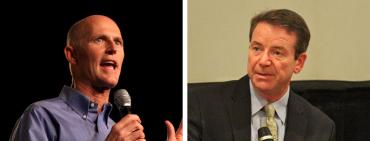
The Florida chapter of the National Federation of Independent Business (NFIB) unveiled its legislative agenda on Tuesday morning with passing Gov. Rick Scott’s proposal to reduce the business lease tax ranking as one of its top priorities.
Bill Herrle, NFIB’s executive director in Florida, said cutting the commercial lease tax from 6 percent to 5 percent would help small businesses across the Sunshine State. The NFIB is one of several members of the business community in the “Cut My Rent 1 Percent” coalition which is currently running TV ads across the state advocating for the tax cut.
“In 2016, we’re focusing on giving back to our state’s economic drivers and helping clear the way for job creators to own, operate and grow their businesses,” Herrle said. “As a result, tax cuts for small businesses are at the top of our list, and NFIB is proud to support Gov. Rick Scott’s ‘Florida First for Jobs’ tax package because it includes something that will benefit almost every business owner in our state.
“We’ve heard loud and clear from NFIB members on how burdensome this tax is, and over 90 percent of them support cutting the business rent tax,” Herrle added. “The business rent tax impacts almost all businesses, but it hits small business owners particularly hard, chipping away at their bottom lines, and that’s why we’re advocating so strongly to reduce it.
The NFIB is also backing direct primary care legislation which, it insists, will reduce health-care costs for small businesses.
“Under the direct primary health-care model, small businesses can contract with a primary care physician and pay a manageable monthly retainer to provide primary care services to employees,” the NFIB noted in its legislative agenda. “These contracts would be supplemented with a ‘wraparound’ insurance policy that provides catastrophic coverage for employees who have major medical emergencies. This model results in cost savings for small business that would otherwise go toward traditional health insurance policies. The savings comes from the physician directly contracting with labs and instead of paying the marked up cost that health-care providers usually bill insurance companies, they pay the true cost of providing those services. These services are often offered at a wholesale price to physicians with as much as an 80-90 percent discount. While this new approach is already legal in Florida, some physicians are hesitant to offer these services without the express approval of insurance regulators in Florida through statute.”
“Small business owners consistently voice that the biggest challenge they face is the rising cost of health-care access,” Herrle said. “Direct primary care helps business owners connect their employees with primary care services, saving business owners thousands a year while ensuring that more workers have access to quality health-care.”
The NFIB also backs Scott’s call to cut taxes on manufacturers and tort and regulatory reform. The group continues to oppose raising the minimum wage and mandatory paid leave.
Reach Kevin Derby at kderby@sunshinestatenews.com or follow him on Twitter: @KevinDerbySSN
