



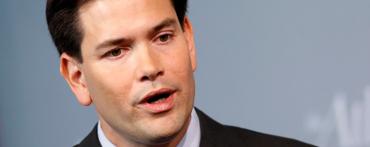
From his perches on the Senate Foreign Affairs and Intelligence Committees, U.S. Sen. Marco Rubio, R-Fla., took to the national airwaves on Sunday morning to weigh in on international policy.
Rubio appeared on NBC‘s “Meet the Press With Chuck Todd” and offered his take on how President Donald Trump was doing on foreign policy in his first 100 days in office. During last year’s Republican presidential primaries, the two candidates clashes on foreign policy and other issues. Trump knocked Rubio out of the contest with a decisive win in the Sunshine State.
“I'm curious,” said Chuck Todd from NBC. “Your colleague, Democratic colleague on the Intelligence Committee, Mark Warner, said this earlier this week of Trump's foreign policy: ‘In Beijing, Moscow, Tehran, they are recalibrating their strategies. You can't deny it. Because they don't have any idea of how Trump will respond. That might be great in the short term, but it's not really a long-term strategy for asserting leadership in a world desperate for American leadership.’ Do you find anything to disagree with Senator Warner on that?”
“Well, I disagree in the sense that I guess from that statement it implies there isn't going to be a long-term strategy,” Rubio answered. “And I know that there is. And they're working on it, and they have great people working on it. The National Security Council is going back to its appropriate role, which is like an internal think tank that designs big, strategic objectives. Just Friday alone, I had a conversation with folks over at the National Security Council about the Western Hemisphere and their strategy towards it. So, we've had a lot of debates in American politics over the last two years about tactics. I think what's important to understand is you have to have a strategy, and then the tactics should be driven by the strategy.
“And I know they're working through it,” Rubio added. “And I do not anticipate that a year from now you're going to be able to say the same thing. And if we are, then that'll be, obviously, opportune for criticism. But I don't think that's where we're going to be.”
“On this reversal on whether it's NATO, the issue of currency manipulation, the decision to strike Syria, these reversals are, in some ways, probably comforting to you on the specifics,” Todd said. “But how do you know he won't reverse himself again? Do you just take more comfort in the fact that he's coming to the sort of status quo? Or are you concerned he could flip again?”
“Well, here's what I take,” Rubio said. “And I said this during the campaign. I think when you're running for president, especially someone that's never held elected office, there's one set of things that you may view the world through-- a lens that you may view the world through. Then, you get elected and you get good people.
“And those good people bring you the facts,” Rubio continued. “And they bring you, ‘Here's what's going on. Here are our options. Here's what happens if you do this. Here's what happens when you do that.’ And that reality begins to assert itself. And you have to react to that. You're now the president. You're no longer a candidate. You're not a pundit. You have to actually make decisions that have real impact and consequence. And I think that's what you're seeing here. I think you’re seeing a president--”
“Do you think he's moving away from maybe the isolationist rhetoric and tendencies that he had as a candidate?” Todd interjected.
“I think he's dealing with the reality of being president of the United States,” Rubio said. “I think he's dealing with the reality of our options oftentimes on foreign policy are not a choice between a good one and a bad one. It's a choice between two less-than-ideal options. And you're trying to figure out which is the least harmful of the two. And I think that's something we should be encouraged by, not something that we should be critical of. This whole flip-flop thing is a political thing. It's something people use in campaigns. But in every other aspect of our life, people change their minds or make different decisions when presented with a set of facts that, perhaps, are different from what they thought. Why should that not be the case, especially for something as important as the presidency?
“Are you saying you'll never use flip-flopping to attack an opponent again?” Todd asked.
“It depends who the opponent is,” Rubio answered. “It depends who the opponent is, right?”
Rubio said that Russia was intervening in the French presidential election, accusing the Putin regime of trying to prop up Marie Le Pen and hurt Emmanuel Macron. The Florida Republican insisted Russia’s ability to intervene in other countries’ politics has been aided by social media and the Internet. Macron and Le Pen prevailed in the first round of the French presidential election and will meet in the runoff next month.
“It appears that both President Trump and former President Obama have expressed a preference unofficially, if you will,” Todd said.
Rubio disagreed with Todd’s point that Trump was backing Le Pen. “Well, I haven't heard the president express a preference,” Rubio said. “I think what I heard the president express was his belief that the terrorist attacks may help a particular candidate. Ultimately, bottom line is the people of France are going to decide it. And I doubt very seriously whether my opinion or the president's opinion or the former president's opinion is going to have an influence over how they vote.
“And there's going to be a runoff,” Rubio added. “And there's going to be a runoff between two candidates, it looks like, with very different points of view. And then, the French people are going to make a decision. And we'll need to react to that one way or the other, in terms of how it impacts our relationship with them. But I'm not sure ‘that the views of an American policymaker are going to have much sway over a French election.
“The chairman of the Intelligence Committee, Republican Senator Richard Burr said there's a lot of evidence that the Russians are playing a role in the French election in the same way they did in the U.S. election,” Todd noted. “Are you investigating that as well in the Intelligence Committee, sort of this overall role that the Russians are trying to do in Western democracies beyond the United States?
“Well, I think there's plenty of open-source reporting to reach that conclusion,” Rubio said. “And the French will tell you that. I was in France about two months ago. And they openly said they're involved, particularly in undermining Macron, who is one of the, I guess, the independent candidate that's running there. And they're trying to prop up Le Pen. And that, of course, is open source as well. She's taken out massive loans in order to fund her campaign and her political operations.
“As far as the general behavior of the Russians, sure, that's something that we're focused on in both foreign relations and also in the Intelligence Committee on an ongoing basis,” Rubio continued. “That's not new. That's always. But let me just say that I don't think I have ever any doubt that these active measures have existed for a long period of time. I think they've just been weaponized to a greater extent over the last two to three years because of the ability to use the Internet and social media and fake news outlets and all sorts of things. And so that is most certainly-- you saw that in the open hearing of the Intelligence Committee. But, quite frankly, multiple committees are looking at that stuff.
In the same interview, Rubio shot down reports of his involvement in arranging a meeting between President Trump and two former Colombian presidents at Mar-a-lago focused on arranging a peace deal with that South American nation’s government and FARC, a far-left guerilla movement which has committed terrorism.
