



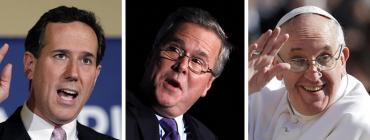
Jeb Bush, who converted to Catholicism, has a papal problem -- and taking a page from the liberal playbook isn't exactly helping.
Appearing on Sean Hannity‘s show on Fox News this week, Bush was asked about Pope Francis‘ encylical on climate change.
“I think religion ought to be about making us better as people, less about things [that] end up getting into the political realm,” Bush told Hannity.
Bush doubled down on his opposition to the pope at an event in New Hampshire on Tuesday.
“I hope I'm not like, going to get castigated for saying this in front of my priest back home,” Bush said. “But I don't get economic policy from my bishops or my cardinals or my pope.”
So no religion in politics and economics? Liberals might agree but that's not where conservatives have been standing in American politics.
Bush would have been wiser to follow the example of Rick Santorum, one of his rivals running for the Republican presidential nomination. Santorum has made his Catholicism one of the hallmarks of his time on the national political stage, even going so far as to showcase his opposition to JFK’s famous speech in Houston back in 1960 when he insisted his religion would not dictate his actions as president.
Santorum never called for Pope Francis to get out of the public square. Instead, the Pennsylvania Republican hit the pope on science.
“The church has gotten it wrong a few times on science,” Santorum said on Fox News earlier this month. True enough with Catholic Church’s handling of Galileo being the best example of this. Even as late as the First Vatican Council in 1870, members of the hierarchy, led by Florida’s own Bishop Augustin Verot, the first bishop of the Diocese of St. Augustine, were still going after Galileo.
In recent years, on issues ranging from Obamacare to abortion, conservatives have been vocal in their opposition to liberals trying to extend the gap between church and state. Led by the late Father Richard John Neuhaus, conservative Catholics -- dubbed “theocons” due to their closeness to neoconservatives -- fought against a “naked public square” where religion had no influence on politics or culture. Often working with evangelical Christians, Neuhaus and fellow conservative Catholics like George Weigel and Michael Novak championed the important role churches can play in American life and they even made inroads into the White House when Bush’s brother sat in the Oval Office. George W. Bush dubbed Neuhaus “Father Richard” and, especially during his 2000 campaign and the start of his presidency, played up his own faith.
Neuhaus and other theocons often pointed to popes as an example of how religious figures could be important in modern politics, cheering John Paul II’s efforts against communism and abortion and praising Benedict XVI’s criticism of the “dictatorship of relativism” undermining the West. Granted they sometimes ignored the popes when they disagreed with them -- Weigel and Novak in particular had major problems with John Paul II’s and Benedict XVI’s opposition to the invasion of Iraq -- but these conservatives usually praised the popes as needed voices in public life.
Now, American conservatives have to deal with Pope Francis who is more vocal about the church’s position on economics than his two immediate predecessors, neither of whom were the biggest cheerleaders for the free market. This isn’t exactly a new trend for the Church. As early as “Rerum Novarum” in 1891, Leo XIII offered opposition to unbound capitalism. Pius XI doubled down on that in “Quadragesimo Anno.” Even Benedict XVI, no liberal to be sure, bashed modern capitalism in “Caritas in Veritate” back in 2009. Some very traditionalist Catholic thinkers and writers from the last century -- G.K. Chesterton, Father Vincent McNabb, Hilarie Belloc -- went after both big government and unchecked capitalism, influencing Southern conservatives in America like Allen Tate and Herbert Agar. Bush telling the pope to keep quiet on economics discards more than a century of Catholic thought.
Instead of telling Pope Francis to remain on the sidelines -- the way liberals love to tell ministers and priests to shut up when they oppose same-sex marriage or abortion -- Bush would have been wiser to follow Santorum’s course. Bush should have said the pope and other religious voices are always welcome in the public square -- even when they are wrong. By saying priests and other religious leaders should keep quiet on politics and economics, Bush is throwing the baby out with the bathwater and standing with liberals who want a naked public square without any religious influences on American politics and culture.
Reach Kevin Derby at kderby@sunshinestatenews.com or follow him on Twitter: @KevinDerbySSN
