



The American Revolution inspired independence movements across the globe from France to South America to the outbreaks that startled Europe in the late 1840s. It’s no coincidence that Emanuel Gottlieb Leutze painted his iconic “Washington Crossing the Delaware” in the aftermath of the 1848 revolutions.
The Hungarian Revolution of 1848 against the Hapsburg monarchy captured the American imagination despite it being squashed by Austrian and Russian forces. Prominent Americans ranging from Presidents Zachary Taylor and Millard Fillmore to Horace Greeley to Daniel Webster tripped over themselves to praise Louis Kossuth, the talented orator and journalist who served as president of the brief Hungarian government set up after the revolution. In 1851, after Kossuth fled to Turkey, the federal government approved sending a frigate to bring him to the United States. For his part, as he toured the United States in 1852, Kossuth cheered the American Revolution. “My principles were those of George Washington,” Kossuth insisted.
One of Kossuth’s chief lieutenants played a dramatic role in Florida’s history. Born in Hungary in 1811, Alexander Asboth was an engineer and soldier who, after having his heart broken as the woman he loved married someone else, joined the 1848 uprising and played an important role in the Civil War. It’s regrettable that Asboth hasn’t found a biographer though engineer and independent scholar Stephen Beszedit, who has done much on the role of Hungarians and the Civil War, has done some excellent work on him.
After rising to the rank of lieutenant colonel in the Hungarian forces, Asboth followed Kossuth into Turkey after the revolution was put down and joined him on his tour of the United States. While Kossuth went back to Europe, Asboth stayed in America, working as an engineer in New York, working with Frederick Law Olmsted create Central Park and helping lay out what is today the Upper West Side.
When the Civil War started, Asboth’s training as a soldier came in handy. Based in New York, he urged his fellow Hungarian-Americans enlist for the North.
“Hungary is once more united stronger than ever, and the different nationalities that lent their assistance in 1848 and 1849 to the treacherous Austrian government in its efforts to crush Hungarian Independence, are now firmly identified with the cause of liberty,” he wrote in the New York Times on May 3, 1861. “While under such auspices we are looking anxiously to our dear native land, hopefully awaiting the long longed-for moment for a renewed gigantic united outburst in behalf and in vindication of our ancient constitution and independence, we see with deep sorrow the glorious republic of the United States, our adopted country, upon the verge of dissolution, the realization of which would be a triumph for all despots and the doom of self-government.”
Like Kossuth, Asboth claimed the legacy of Washington and the Founding Fathers.
“In this distracted state of the country, it behooves us Hungarians to remember that we belong to that nation which struggled gallantly, but unsuccessfully, for that same liberty, which crowned the efforts of Washington,” Asboth insisted. “It behooves us to remember that, when after the disastrous termination of our national struggle, at the demand of Austria and Russia, Gov. Kossuth, our chief, with others of us now here, were detained by the sultan in Asia Minor, the generous intervention of the United States set us free, and the national steam-frigate Mississippi, under the glorious flag of Stars and Stripes, brought us safely from a gloomy prison to the free shores of America.
“The sympathy and assistance thus bestowed upon down-trodden Hungary and its scattered exiled souls imbued me with a feeling of everlasting gratitude, and ten years of citizenship of this republic, by virtue of which I have enjoyed the blessings of its institutions, render me doubly impressed with all its duties and obligations, as deeply and as earnestly as if I were native of the soil,” Asboth added. “Thus actuated, I have already offered my military services to the government. Many of you have done the same, and I feel confident that you all share my sense of indebtedness to the United States, and would feel equally gratified with myself in attesting it by substantial service. You all know the value of the Union as it was, and will stand by it faithful and true, and defend it at all hazards, with that same firmness and gallantry displayed so emphatically in the defence of your own native land, the rights and constitution of Hungary. To embody these sentiments in a practical form, we Hungarians in New York and its vicinity must meet, confer, unite and organize.”
Asboth served as chief of staff for Gen. John Fremont when that former presidential candidate and renown explorer commanded Union forces in Missouri. Fremont barely lasted three months in command as his efforts against slavery went beyond what the Lincoln administration was willing to back in the early stages of the war. Surrounding himself with Asboth and other immigrants didn’t help Fremont either. In his memoirs, General John Pope insisted Fremont’s staff full of European exiles was more concerned with pomp and procedure than actual military affairs. Despite that perception, Asboth garnered applause for his efficiency, especially in helping organize and train regiments of volunteers as Fremont gave him command of a division.
After Fremont being relieved from command, Asboth, now a general, remained with the army in Missouri. The famed English writer Anthony Trollope met Asboth in early 1862 and was impressed with the general.
"We dined at the tent of General Asboth, and afterwards rode his horses through the camp back to Rolla,” Trollope wrote. “I was greatly taken with this Hungarian gentleman. He was a tall, thin, gaunt man of fifty... who had come from his own country with Kossuth to America. His camp circumstances were not very luxurious, nor was his table very richly spread, but he received us with the ease and courtesy of a gentleman. He showed us his sword, his rifle, his pistols, his chargers, and a daguerreotype of a friend he had loved in his own country. They were all the treasures that he carried with him, over and above a chess-board and a set of chessmen which sorely tempted me to accompany him in his march."
Asboth led his division at the Battle of Pea Ridge in March 1862 where he was wounded in the arm and later served as Union forces in the West converged in Mississippi for the the siege of Corinth. During his time in the Western theater, Asboth impressed General William Tecumseh Sherman who praised the Hungarian immigrant in his memoirs for his courage and who called on Ulysses S. Grant’s staff to give Asboth important commands.
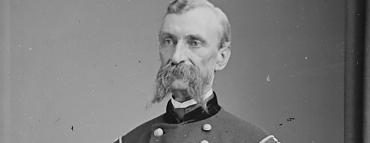
"General Asboth was a tall, spare, handsome man, with gray mustache and a fierce look," Sherman wrote in his Memoirs. “He was an educated soldier, of unquestioned courage,, but the responsibilities of outpost duty borne rather heavily on him, and he kept all hands in a state of constant worry in anticipation of imaginary attacks."
While he spent much of 1863 in Kentucky and Ohio, Asboth was given command of the Department of West Florida based out of Pensacola. During his tenure in Florida, Asboth focused on bringing former slaves into the Union army and launching raids in the area. Decades after his time in Florida, historians were still noting the locals hated Asboth for being an immigrant and fighting against slavery.
At the head of a column of 700 men, including former slaves now serving as American soldiers, Asboth was wounded at the Battle of Marianna, part of a dramatic and bloody raid in September 1864 which the fine historian Dale Cox has covered and written about extensively.
At Marianna, Asboth was shot in the left arm and, while doctors did not have to amputate it, the general lost the use of it. Asboth also had a bullet lodged in his cheek leading to bone fragments and puss oozing out of it for some time to come.
William Harrison Clayton, a solder in the 19th Iowa Infantry, wrote about Asboth as he recovered from his wounds in Pensacola. "He appears to suffer a good deal of pain,” Clayton wrote. “The general is quite grey-haired and looks as though he was about 60 years of age. He is a Hungarian - one of the Kossuth staff during the Hungarian war, and speaks English brokenly. He appears to be a go-a-head sort of man, and seems to think a good deal of his men."
After recovering in Pensacola and New Orleans, Asboth was able to resume command of the Department of West Florida but the wounds continued to trouble him for his few remaining years. President Andrew Johnson promoted him to a brevet major general to recognize his services. Johnson also named Asboth to serve as ambassador to Argentina and Uruguay in 1866 during a crucial time in those nations’ history. Along with Brazil, those two South American nations were battling Paraguay in the War of the Triple Alliance, one of the bloodiest conflicts of the nineteenth century. Asboth led American efforts to mediate the conflict but he finally succumbed to his wounds in January 1868.
First interned in Buenos Ares, Asboth’s remains were moved to Arlington National Cemetery in 1990 in a solemn ceremony. U.S. Rep. Frank Horton, R-NY, took to the House floor to praise Asboth.
“This deeply religious man was as much an American patriot in the latter part of his life as he had been a Hungarian one at the beginning,” Horton said. “At one time, he expressed his attachment to his second homeland by saying, `It is in the free soil of North America in which I would wish to rest in eternal peace . . ..' With the return of his remains to the United States, his above expressed wish will finally be honored.”
While he did not attend the ceremony at Arlington National Cemetery as Asboth was buried there, President George H.W. Bush penned a leader which was read at the event.
“This is a solemn occasion, but it is also a time to celebrate the legacy of an outstanding American--a patriotic man of great courage and conviction,” Bush noted. “Ambassador Asboth, like all heroic individuals, stood up for what he believed. He fought against oppression in Hungary, and after arriving in this country, he fought in the Civil War to help keep his newly adopted homeland united. Following the war he continued serve our country with distinction, acting as its Ambassador to Argentina. This champion of freedom has earned a lasting place of honor in the history of three countries--the United States, Hungary, and Argentina--and his memory continues to unite us today.
“I commend the Hungarian Freedom Fighters Federation U.S.A. for your efforts to bring home the remains of Ambassador Asboth,” Bush added. “He would be grateful for your efforts, and he would be proud of the role you have played in helping to fulfill his dream of a free and democratic Hungary.”
Asboth’s career was an odd one to be sure taking him from Hungary to Missouri to the Florida Panhandle to, finally, Argentina. But through it all, Asboth was dedicated to self-government, whether it was Kossuth’s attempts to bring an American style democratic republic to Hungary or his opposition to human slavery. As he noted in his letter to the New York Times at the start of the Civil War, Asboth saw himself serving the same cause as Washington and the American Revolution. Those ideals drove him across the globe as he served his adopted nation.
