



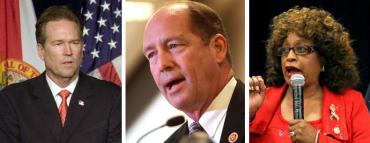
After almost 130 amendments, the U.S. House passed the “Surface Transportation Reauthorization and Reform Act” on Thursday, funding federal transportation projects through 2021.
The bill could lead to $325 billion for transportation projects. The vast majority of that--more than $260 billion--will go to highways.
The measure passed 363-64, a victory for new U.S. House Speaker Paul Ryan, R-Wisc. Only six Democrats voted against the measure while 58 Republicans opposed it.
Only four members of the Florida delegation--Republican U.S. Reps. Curt Clawson, Rich Nugent, Bill Posey and Ted Yoho--voted against the measure.
The House will now confer with the U.S. Senate as they attempt to reconcile their bills before Nov. 20 when current funds expire. U.S. Rep. Corrine Brown, D-Fla., will be one of the House’s conferees.
U.S. Rep. Vern Buchanan, R-Fla., noted that Florida would get $11 billion for repairing highways in the bill, including projects on I-75 and US 301 in his district.
“This bill provides critical funding to repair our roads and bridges,” Buchanan said. “It’s another example of what Washington can do when both parties work together on behalf of the country.”
Brown also showcased her support for the bill on Thursday.
“This important legislation included a critical freight grant program, additional programs and funding for transit systems and their operators, continues the Transportation Alternatives Program (TAP) and creates a new non-motorized safety grant program, includes a much needed extension of Positive Train Control (PTC) implementation, increased funding for Grade Crossings, Requires more information on Hazardous Trains to State Emergency Response Commissions, incentivizes states to combat racial profiling, and extends the Disadvantaged Business Enterprise (DBE) Program,” Brown said. “Unfortunately, without critically needed additional funds, we’re robbing Peter to pay Paul and forcing our states and local transportation agencies to pay more for New Starts and other programs while limiting their flexibility to use these funds. And were missing out on an opportunity to ensure our infrastructure is meeting the needs of the disadvantaged and working class to ensure they have fair access to employment and economic centers.
“I believe wholeheartedly that reauthorizing a surface transportation bill will give the economy just the type of boost it needs. A long term transportation bill will strengthens our infrastructure, provides quality jobs, and serves as a tool to put America back on a path toward long-term economic growth,” Brown added. “Every day we delay passing a long term bill, we fail to create critical jobs and we increase the price of these vital infrastructure projects.
“Transportation and infrastructure funding is absolutely critical to the nation, and if properly funded, serves as a tremendous economic boost and job creator,” Brown insisted. “In fact, Department of Transportation (DOT) statistics show that for every $1 billion invested in transportation infrastructure, 44,000 jobs are created along with $6.2 billion in economic activity.
The traveling public is pleading with Congress to make transportation infrastructure a priority. When that happens, we can put millions of hard working Americans back to work fixing our nations crumbling infrastructure and preparing our country for the future.”
U.S. Rep. Carlos Curbelo, R-Fla., also made the case for why the bill was needed.
“For far too long, Congress has kicked the can down the road by providing short-term patches to transportation funding, causing uncertainty for our local and state governments as they work to repair our nation’s failing infrastructure,” Curbelo said. “This important bill authorizes surface transportation programs for six years and improves our nation’s infrastructure system by prioritizing funding and providing more flexibility to states.
“I am pleased that several of my initiatives, which will greatly benefit South Florida, were included in the House-passed bill. As a strong advocate for transportation safety – Miami is the fourth deadliest city in the country for pedestrians, according to AARP – I was pleased to include language that would direct states to develop roadways with the safety of everyone in mind, including public transportation vehicles and riders, pedestrians, bicyclists, and motorists,” Curbelo added. “I was also pleased to see robust authorization levels for the important University Transportation Center program, which will receive $72.5 million per year with incremental increases over the next six years. 125 universities across the country participate in the UTC program, conducting critical research to develop future transportation technologies. Florida International University in our congressional district is a world-recognized leader in Accelerated Bridge Construction and I’m proud to advocate on their and all the UTCs behalf here in Congress.”
Yoho pushed back against the bill, saying it was bogged down with matters that had nothing to do with transportation and calling out how the funding would be handled.
“I am in favor of supporting a bill that focuses on repairing and improving our bridges, roads, the transportation system as a whole and the everyday lives of Americans across the country,” Yoho said. “By sticking to that main objective, we will strengthen our economy and make us more competitive in the global economy. We can all agree that our nation’s transportation infrastructure is crumbling and in need of major repairs. Unfortunately, the bill before us today still continues the practice of using the Highway Trust Fund for projects that are not related to the user fees that go into the fund.
“We need a bill that purely addresses surface transportation, not one that diverts money for things like historical preservation and landscaping,” Yoho continued. “With a nation soon to be over 20 trillion dollars in debt, we need to prioritize funding and put tax dollars towards our critical needs. I offered an amendment that would have not allowed funding for new non-motorized trails and paths. This would have saved $154 million dollars while maintaining all existing trails and paths. We need to keep our federal spending focused and cut spending on non-essential items.
“Finally, the bill voted on today has other things added to it that have nothing to do with the original bill; most notably the attachment of the Export Import bank into this bill,” Yoho said. “What does Export-Import bank have to do with a surface transportation bill? Nothing. I also have a hard time supporting a bill - which has been plagued by short-term extensions in the past – that is only funded for three of the six years of its life. This is a major priority for the country and should be funded fully.
“The health of our nation’s infrastructure is vital to the safety of all Americans, vital to our economy, our global competitiveness, and making our country strong. I believe in rebuilding America. This bill should focus just on that and nothing else, ” Yoho said in conclusion.
Reach Kevin Derby at kderby@sunshinestatenews.com or follow him on Twitter: @KevinDerbySSN
