



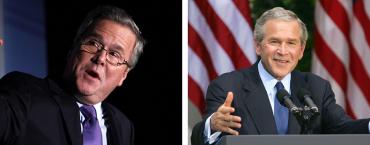
Down in the polls and now running out of time, Jeb Bush opened the door this week to having his brother George W. Bush hit the campaign trail with him as he tries to salvage his bid for the Republican presidential nomination.
Appearing on “Fox and Friends” on Fox News on Tuesday morning, the former Florida governor told Brian Kilmeade that the former president could end up campaigning with him.
“It is something to consider because he is very popular,” the candidate said about his brother. “And I also know I need to go earn this.”
Certainly George W. Bush’s numbers are better with Republicans than they are Democrats or voters outside the two major parties. The Republicans also haven’t won a presidential election without a Bush on the ticket since 1972. The former Florida governor has been wise enough to rely on the two presidents in the family to help boost fundraising.
But former presidents generally don’t do well on the campaign trail even as, on the other side of the aisle, Hillary Clinton turns to her husband Bill to help rally Democrats behind her own presidential bid.
Already the Bushes are drawing fire from the left. Jessica Mackler, the president of liberal group American Bridge, quickly went to work poking holes in the former president’s record.
"American Bridge looks forward to welcoming President George W. Bush back to the campaign trail and discussing his record on the economy and foreign policy during his term,” Mackler said on Tuesday. "After all, every Republican from Jeb Bush to Marco Rubio and Donald Trump has doubled down on his disastrous economic policy that resulted in the Great Recession and his failed neo-con foreign policy that involved the U.S. in two Middle East ground wars. Nothing like the man himself to remind voters of the Republican creed."
Some of the other Republican presidential hopefuls are also ready to go after the former president. Currently leading the national polls and in key states like New Hampshire and South Carolina, Trump came on MSNBC’s “Morning Joe” on Wednesday morning and bashed Bush.
Asked when America stopped being great, Trump took aim at the second President Bush.
“I was very unhappy with the Bush years,” Trump said. “I was very unhappy with the fact that Bush went into Iraq.”
Former presidents have offered a mixed record on the campaign trail. Bill Clinton is already hitting the road for his wife but he did not help her back in 2008. Four years ago, Clinton did prove one of Obama’s better surrogates and he won high marks for his speech at the Democratic convention.
But more often than not, former presidents flounder as they try to help candidates after their time in the White House. Democrats have generally given Jimmy Carter the cold shoulder while Republicans did the same for Richard Nixon for obvious reasons. After running his mouth and costing himself a spot on the 1980 GOP ticket as old rival Ronald Reagan’s running mate, Gerald Ford spent his post presidential years urging George W. Bush to dump Dick Cheney and George H. W. Bush to jettison Dan Quayle. While he gave speeches at many Republican conventions over the years, Herbert Hoover proved more a hindrance than a help to most of his party’s candidates and it’s telling that Democrat Harry Truman had more use for him than did Republican Dwight Eisenhower. While he was a solid chief justice of the Supreme Court after his presidency, William Howard Taft spent the 1920 election insisting Warren G. Harding was more of a supporter of the League of Nations than he actually was.
Ex-presidents like Teddy Roosevelt, Millard Fillmore and Martin Van Buren actually ditched their parties to run on third party tickets. Fillmore and Franklin Pierce would draw heavy criticism for their opposition to Abraham Lincoln and their houses would be vandalized after Lincoln was assassinated. After his presidency, Andrew Johnson ran for office numerous times and, after finally getting back to the Senate, quickly died. In 1880, almost four years after his presidency ended, Ulysses S. Grant was denied the Republican nomination. After leaving the White House, John Tyler spent years in the political wilderness only to reemerge in his final years to lead an unsuccessful peace conference to avert the Civil War and dying as a member of the Confederate Congress. Even John Quincy Adams, generally considered the most successful former president to return to politics, had a few setbacks after being tossed out of the White House though his long tenure in the Congress as the leading voice against slavery ensured he remained a major political player.
Americans generally want their former presidents to remain statesmen, not politicians. It’ll be interesting to see how voters treat both George W. Bush and Bill Clinton as they gear up for the 2016 election.
Reach Kevin Derby at kderby@sunshinestatenews.com or follow him on Twitter: @KevinDerbySSN
