



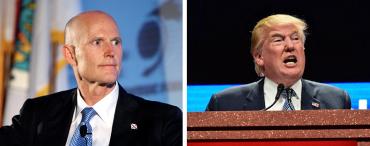
Donald Trump enters the presidency without ever having held public office--but a politician from Florida can offer a roadmap on how he can govern.
Of course, Trump is not the first president to enter the White House without political experience. But generals like Ulysses S. Grant and Dwight Eisenhower oversaw large federal efforts and, in Ike’s case, coordinated his efforts with other nations. With the possible exception of Zachary Taylor, another general but one who did not manage the numbers that Grant and Eisenhower did, Trump has the least experience of any new president when it comes to the federal government and politics which, of course, was a large part of his appeal.
Trump faces a divided nation, a hostile media and, while Republicans control both chambers of Congress, the GOP leadership hasn’t exactly gotten along with the president-elect. In fact, Trump’s nomination and election was a direct repudiation of them.
If this sounds familiar to Floridians, it should. Rick Scott found himself in much the same situation when he was elected governor back in 2010. The GOP leadership stood behind Bill McCollum in the primary and Scott has had some problems with the Republican controlled Legislature during his six years in Tallahassee. Nonetheless, there is much Trump can learn from Scott’s leadership.
Both Trump and Scott made the jump from the business world to political office but there are some major differences between them. Scott is far more awkward on TV than Trump is. The president-elect’s personal life has often landed him in the tabloids while Scott always reminds the world that his wife was his high school sweetheart.
After a narrow win over Alex Sink, Scott was upside down in the polls and facing legislative leaders who backed McCollum. Having made “let’s get to work” his main campaign slogan, Scott focused on the economy and job creation. There have been some stumbles to be sure--including last year’s battle with the Legislature over funding Enterprise Florida and his failed push to eliminate the manufacturing sales tax--but for the most part Scott has scored some wins on the economic front. That success has seen Scott’s numbers creep up and helped him win a second term in 2014. Trump would do well to Even with as much controversy as its cause, Trump’s business background can help boost his credentials on the economy.
Scott’s also not been afraid to reject the GOP playbook on certain issues. Take higher education for example. Instead of too many Republicans who insist proprietary schools, which often rely on federal funds including Title IV and Pell grants, follow free market principles, Scott focused on schools in the Florida College System, pushing them to offer affordable degrees, including keeping tuition at $10,000 or less. Trump’s shown no problem with breaking with GOP orthodoxy during his campaign, something which he might do in the face of Mitch McConnell and Paul Ryan.
Trump could also learn from Scott’s demeanor during crises. In recent weeks, with the Big Bend and the Atlantic Coast hit by hurricanes, Scott was at his best, the way political leaders often have to be when facing crises.
Of course, Trump will be facing greater challenges in the White House than Scott or any governor ever will. But Scott provides a decent model on how an outsider who doesn’t always get along with his party’s legislative leadership can get the job done. Trump and his team would do well in taking a few notes on how Scott has done in Tallahassee.
