



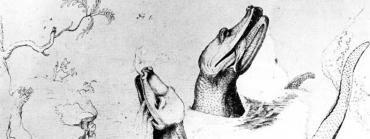
The Center for Interdisciplinary Writing and Research (CIWR) at Daytona State College released the first of two issues of the Journal of Florida Studies (JFS) focused on the 250th anniversary of John and William Bartram’s first journey to Florida.
Casey Blanton, the editor of JFS, showcased the first issue of “Travel and Travels” at the end of last week. The second issue focused on travels through Florida is scheduled to be released in early April.
“Travel and Travels blends creative and scholarly work in its exploration of the Bartrams and their world from a variety of disciplines, including history, poetry, science, art, rhetoric, ,photography and documentary film,” Blanton said. “It is an amazing issue that we are happy and proud to share.”
Based mostly out of Philadelphia, the Bartrams were two of the leading American naturalists of their era. Often considered the father of American botany, John Bartram was appointed King George III’s royal botanist for North America while his garden was a popular attraction. Before his trip to Florida in 1765-1766, Bartram had won international acclaim for his studies of plants in Canada and what is now the Great Lakes region of the U.S.
In the summer of 1765, John Bartram headed down to the Carolinas where his son William was residing in the Cape Fear area to study the American Southeast. Meeting with political leaders like South Carolina merchant Henry Laurens, who would later lead the Continental Congress during the American Revolution, and James Grant, the British governor of East Florida, the Bartrams explored the area, studying the animals, plants and ecology.
Reaching St. Augustine in October, the Bartrams explored the immediate area, including Anastasia Island, before heading to Picolata as Grant met with leaders of the Creek tribe. In December, the Bartrams headed south, looking for the source of the Saint Johns River. They traveled as far as Lake Henry before their progress was blocked. John Bartram headed back to the Carolinas in March, 1766 but William stayed in Florida in an ill-advised attempt to run his own plantation. Bailed out by his father on Laurens’ advice, William Bartram abandoned his plantation after a year and a half and headed back to Pennsylvania.
But William Bartram hadn’t quite worked Florida out of his system. Much to his father’s disapproval, William started musing about returning to Florida in the early 1770s. After getting a commission from Dr. John Fothergill, an English physician who owned one of the largest botanical gardens in England, he traveled to the Southeast in 1773 and returned to Florida a year later. Named “Puc Puggy” by the Seminoles, their term for “flower hunter,” Bartram chronicled his findings in Florida and the Southeast before heading back to Philadelphia in January 1777, a few months before his father died.
After the Revolutionary War, William Bartram remained a prominent figure and George Washington, Alexander Hamilton, James Madison and other Founding Fathers visited his gardens during the summer of 1787 as they shaped the Constitution. Bartram published his account of his travels in 1791, containing descriptions of the flora and fauna he encountered and several of his drawings. Bartram’s “Travels” was a success from the start as readers took in his experiences with alligators, birds and exotic plants. It was published in London in 1792 and Ireland a year later and leading writers like Romantic poets William Wordsworth and Samuel Taylor Coleridge in England and horror novelist Charles Brockden Brown in America cherished the book. Coleridge even claimed that reading “Bartram’s Travels” helped shape “The Rime of the Ancient Mariner” and “Kubla Khan.”
After President Thomas Jefferson launched the Lewis and Clark expedition to the West, he asked Bartram, now in his mid-60s, to be the natural history advisor to an expedition to the Red River region. Bartram declined the offer and a later one to visit St. Louis though he kept up his scientific studies until he died in 1823 at the age of 84.
Bartram is honored in Florida and the Southeast, including a canoe trail in Alabama, a building at the University of Florida and a town on the First Coast named after him. Most fittingly, the “William Bartram Scenic & Historic Highway,” one of the most beautiful drives on the First Coast, runs south of Jacksonville through St. Johns County, along the river which played such a prominent part in the naturalist’s life.
Along with the plants and animals first classified by them, "Bartram’s Travels” remains the biggest legacy of the Bartrams' trips to Florida as the book offered people around the world an introduction to the wonders found in Florida. It’s had a bit of a revival in recent years as the Library of America, the closest thing the U.S. has to a literary pantheon, included it for publication in 1996 while Nicole Kidman’s character gives Jude Law’s character a copy of the book in the 2003 Civil War film “Cold Mountain."
Reach Kevin Derby at kderby@sunshinestatenews.com or follow him on Twitter: @KevinDerbySSN. Kevin first stumbled across the Bartrams when reading longtime U.S. Rep. Charlie Bennett’s, D-Fla., “Twelve on the River St. Johns” back in high school and has been pursuing them ever since.
